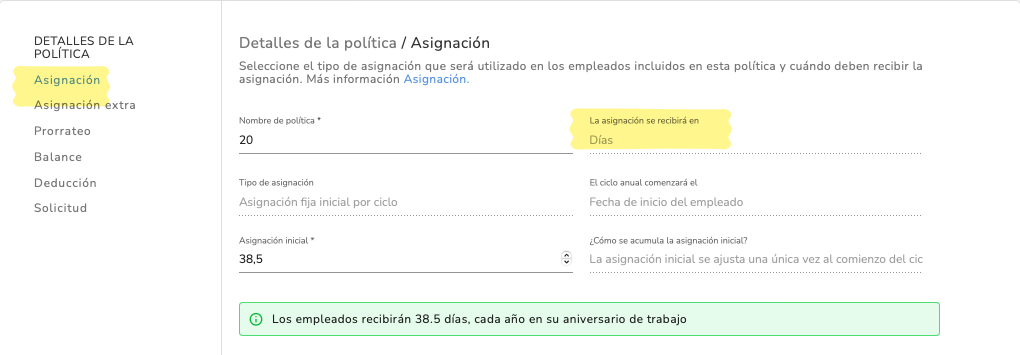
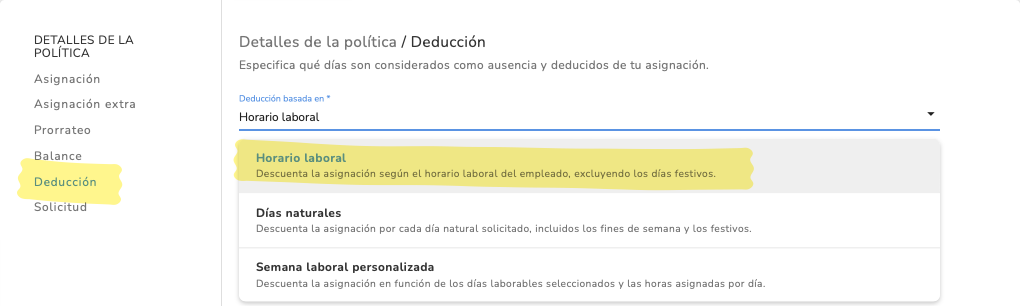
Note: For irregular work schedules, we recommend setting the Time off entitlement in the policy settings to days and selecting the Work schedule for the deduction.
Admins must clearly communicate to employees with irregular working hours how time off requests should be formulated, depending on how their time off policies are set up.
Case 1: Requesting time off without a published shift plan
If no shift plan has been published yet, how employees should request time off depends on the time off policy.
Example:
Connie has 21 weekly hours and works flexibly (3–5 days per week). Recently, she has mostly worked Thu–Sat.
She wants to request a full week of time off well in advance – before a shift plan exists.
Scenario A: Deduction by work schedule (recommended)
Time off is calculated based on the scheduled working time.
- If Connie only requests Thu–Sat, the request will be rejected
→ The system recognizes these days without a shift plan as non-working days - Instead, the system distributes the expected hours to other days (e.g., Mon–Wed)
- If Connie only requests Thu–Sat, the request will be rejected
✅ Correct: Connie should request the entire week
→ 21 hours / 3 days of time off will be automatically deducted
Scenario B: Deduction by calendar days
Time off is calculated for every calendar day.
- Connie can request Thu–Sat → 3 days of time off will be deducted
- If she requests Mon–Sat, 6 days of time off will be deducted
In short
- Deduction by work schedule → always request the entire period (recommended)
- Deduction by calendar days → request only the actual days of absence
Conclusion
Choose the time off rule based on your needs:
- Reflect work actually performed?
→ Deduction by work schedule (standard & recommended) - Count the entire absence (e.g., if legally required)
→ Deduction by calendar days
Case 2: Requesting time off with a published shift plan
If you record an absence for an employee in the near future (e.g., in the case of a sick leave notice), you must pay special attention to a published shift plan to only delete shifts after the time off request has been fully processed.
If you remove shifts in the published shift plan too early, the system can no longer correctly calculate how many hours must be deducted. This can lead to the deduction not being correctly applied or needing to be corrected later.
Basic rule for deleting shifts
- Retroactive requests: The deduction is processed immediately upon approval. You can then immediately delete the shifts in the published shift plan or leave them unchanged.
- Future absences: The deduction is only processed on the first day of the absence at 00:00 AM. You may only delete the shifts in the published shift plan after that. (!)
Example
Michael has 30 contractual weekly hours, works 3–6 days per week, and is available from Monday to Saturday. This week he is scheduled in the published shift plan from Monday to Thursday and calls in sick for the entire week on Sunday evening.
Scenario A: Accounting by work week according to work schedule
Michael submits a time off request for the entire week (Mon–Sat) or only for his planned working days (Mon–Thu).
Your procedure as an Admin:
- Sunday: You leave all shifts in the published shift plan so the system can calculate correctly.
- Monday morning: As soon as the deduction has been processed, you can delete the shifts from Monday to Thursday.
Result:
In both cases, the system records 4 sick days (Mon–Thu), as only the actually planned working days are taken into account.
Scenario B: Accounting by calendar days + work schedule
Michael submits a time off request for either Mon–Thu or Mon–Sat.
Your procedure as an Admin:
- You can delete the shifts in the published shift plan at any time or convert them into open shifts.
Result:
- Mon–Thu → 4 sick days
- Mon–Sat → 6 sick days (based on availability according to the work schedule)
In short
We recommend that you do not account for sick leave notices in Germany by calendar days.
The reason: For payroll purposes, only the actually planned working days should be taken into account. This is also important for correct reimbursement by health insurance providers.
The same applies to time off: The decisive factor is always the actually planned working days according to the work schedule.
Was this article helpful?
That’s Great!
Thank you for your feedback
Sorry! We couldn't be helpful
Thank you for your feedback
Feedback sent
We appreciate your effort and will try to fix the article