Your roadmap for a smooth year-end
The end of the year is approaching! It’s a valuable time to pause, reflect on experiences, and set new goals. But before you can focus on what really matters, you need to get your business processes in shape. We want to ensure that you’re fully prepared: here you’ll find our list of proven methods and best practices. Act now and follow our recommendations until the end of the cycle.
TABLE OF CONTENTS
✅ All employees should request their future leave
Before the cycle ends, all your employees should request the leave days they want to take in the current cycle so that no changes need to be made retroactively. And while we’re talking about requests, we suggest that this is also a good opportunity to remind your employees about your time-off policies and the carryover of leave days.
Follow the steps below to make sure you share the correct information about the carryover configurations you have set for the current cycle:
Go to Time off > Settings and click one of your absence types to check whether they include carryover.
Click the three dots next to the absence types that have carryover days to review the details.
Under Policy settings > Balance, check the date until which the carryover can be used and the maximum number of days your employees are allowed to take.
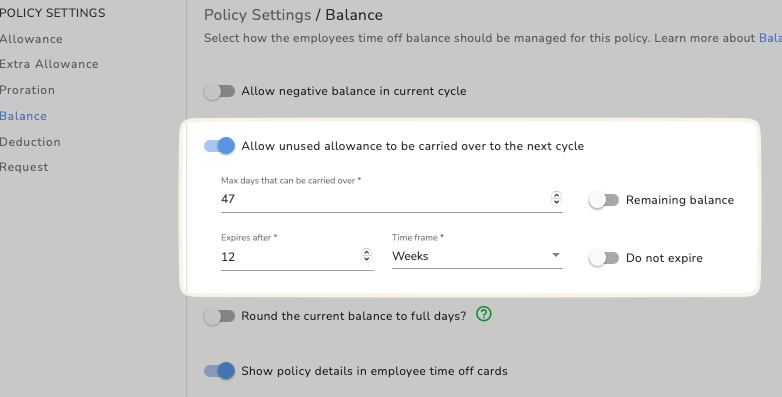
Note: If you want to change this configuration before the end of the year, remember that changes to the policies may affect active employees in this cycle.
Best Practice:
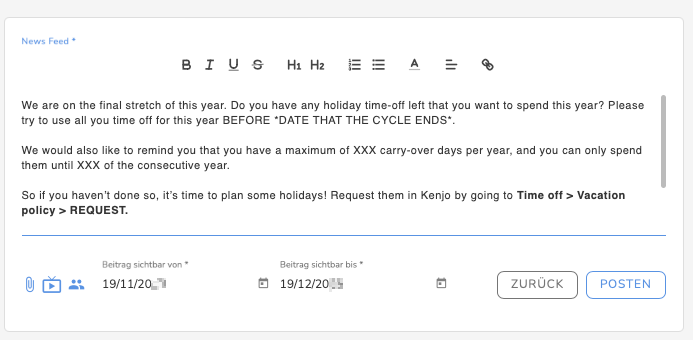
Use Kenjo’s announcement feature to inform and remind employees about your time-off management policies.
- Go to Home > Announcement (News Feed)
- Now just quickly add a Description and a Date from which the post should be visible, and all employees will be informed.
Here’s a small example:
Example text:
Hello,
We are on the final stretch of this year. Do you have any holiday time-off left that you want to spend this year? Please try to use all you time off for this year BEFORE *DATE THAT THE CYCLE ENDS*.
We would also like to remind you that you have a maximum of XXX carry-over days per year, and you can only spend them until *DATE* of the consecutive year.
So if you haven’t done so, it’s time to plan some holidays! Request them in Kenjo by going to Time off > Personal and REQUEST.
Best,
Your HR Team
We would like to point out that such a general message about vacation days is not legally sufficient.✅ Add custom holidays in calendars for next year
- Go to Settings > Public Holiday Calendar
- Check the calendars again and add the new custom holidays for the next year
- Remember that your Custom Holidays are not automatically renewed for the consecutive year so make sure you repeat this process for all calendars you have.
Best practice:
You can create a workflow that will remind you of this process:
- Email template:

- Workflow configuration:

- Add a workflow action

✅ Create periods with time off restrictions
With the time-off restriction feature in the time off settings, you can automatically and transparently define periods during which some or all of your employees cannot request vacation. Set these up now for the upcoming year. You can choose which attendance policies the restriction should apply to.
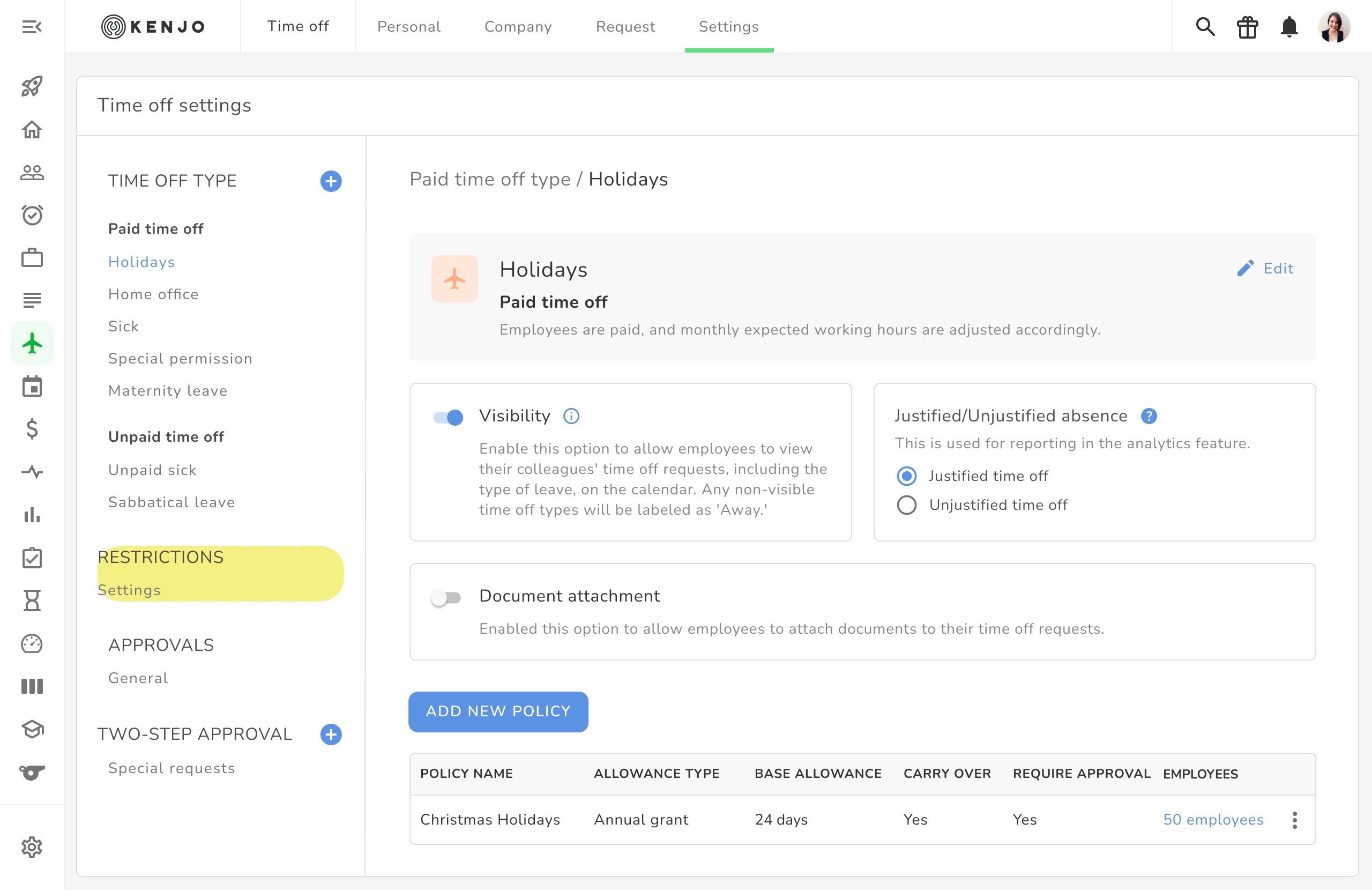
- Go to Time off > Settings
- Find RESTRICTIONS in the vertical menu and click on Settings
- Click ADD RESTRICTION
For more details, read this article.
✅ Review Approvers for Time Off
Review your settings for time-off approvers and delegated approval. You can make changes to time-off approvers for each employee in their employee profile under the Time-off approver field.
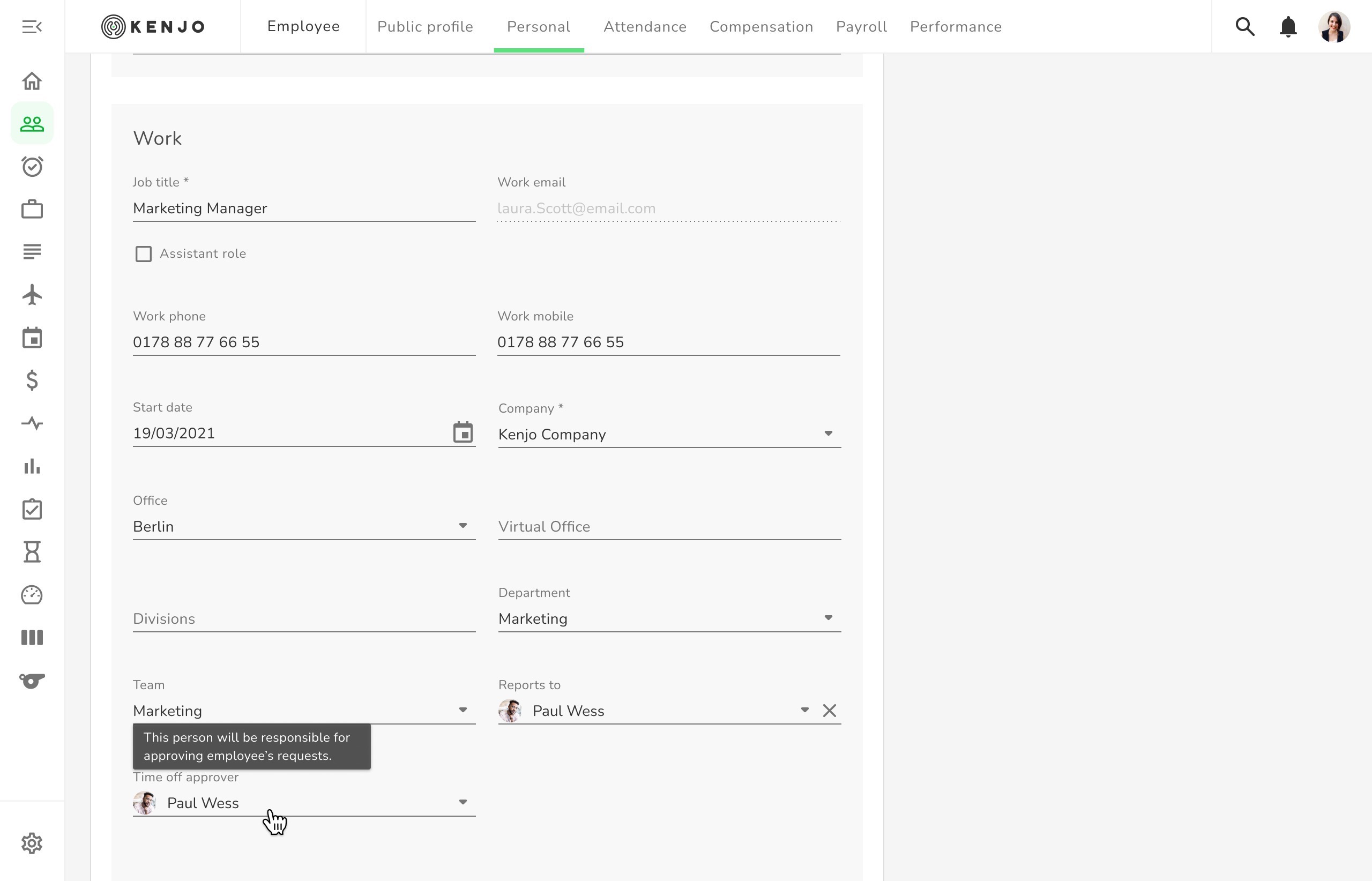
If you haven’t set up additional time-off approvers, delegated approval, or two-step approval yet, you can do so under Time Off > Settings in the left menu.
✅ Assign time-off policies for next year
You’ve created new policies for the coming year? Then remember that you still need to assign them to the relevant employees.
- Go to Time off and select any policy to assign it in bulk using the Assign employees action.
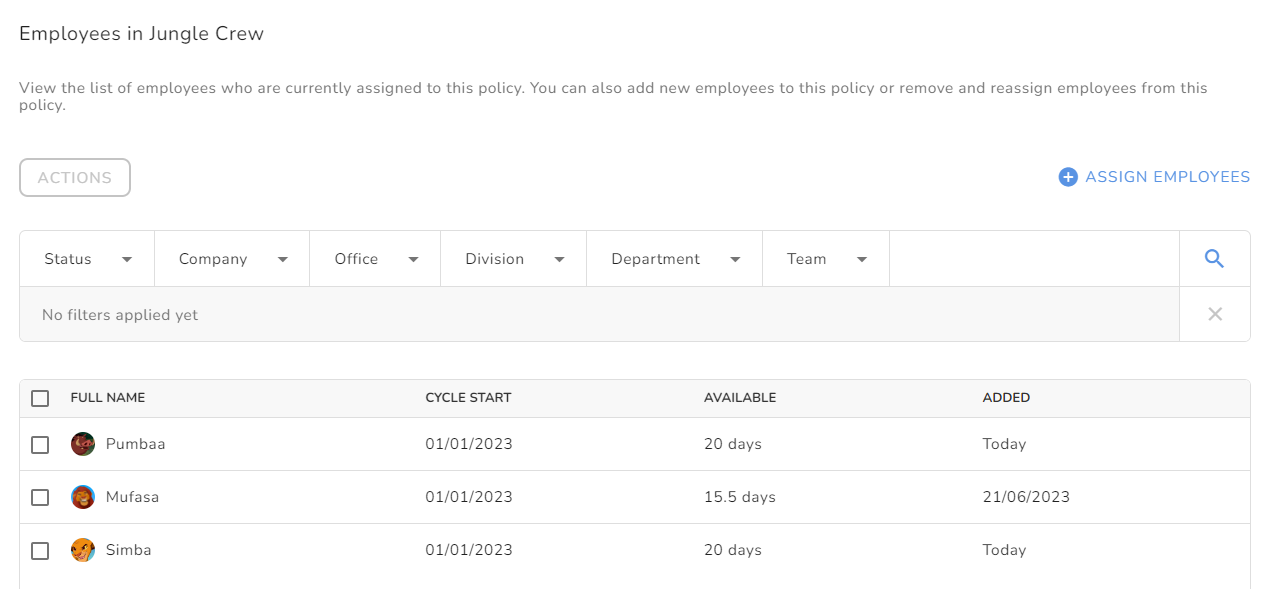
For more details, also read our articles Assigning time-off policies to employees and Creating time-off types.
✅ Review your current policy settings
Remember that we’ve added many new options to policies, and many of them affect the transition into a new cycle. Please check your default time-off policies, especially with regard to additional entitlement, adjustments (proration) and deduction. For more details on policy settings, read this article first.
Extra Allowance
In the next step, you can configure the extra allowance rules. You can add extra allowance rules to automatically increase the policy's base allowance based on how long an employee has been in the company. If you do not wish to create any extra allowance rules, you can skip this step.
You can add an extra allowance rule by clicking on (+) ADD EXTRA ALLOWANCE RULE.

Time worked (years): Tenure in years, calculated from employee's start date
Extra allowance days/hours: Allowance to be provided in addition to the Base allowance
Let's take an example,
Annual cycle: January 1st
Grant method: At once, beginning of the cycle on Jan 1st
Base allowance: 24 days
| Rules | Timeline & Allowance grant |
|---|---|
| Rule 1 Time worked (years): 1 Extra allowance days: 1 Total allowance = 25 | 15th Mar '24: Employee start date 1st Jan '25: Employee receives 24 days at once 15th Mar '25: Employee receives the 1-day extra allowance (Rule 1) 1st Jan '26: Employee receives 25 days 15th Mar '26: Employee receives the 1-day extra allowance (Rule 2) Note: Extra days are given as the difference between the Total allowance from Rule 2 - Rule 1 1st Jan '27: Employee receives 26 days 15th Mar '27: No extra allowance rules 1st Jan '28: Employee receives 26 days |
| Rule 2 Time worked (years): 2 Extra allowance days: 2 Total allowance = 26 |
When you are done, click on ADD. You can add as many extra allowance rules as you want. Lastly, click on NEXT.
Proration
Next, you can choose whether the policy base allowance should be prorated (adjusted) for new employees, part-time employees and employees with a contract end date.
To make it easily understandable, let's take three examples with a different proration option. In this example the:
Option 1: Based on Employee’s Start Date
Let's take an example,
Annual Cycle Start: January 1
Grant Method: At once, beginning of cycle
Base Allowance: 24 days
Employee Start Date: March 15, 2024
| Proration Type | Calculation | Result |
|---|---|---|
| No Proration | Full base allowance granted regardless of start date. | 24 days |
| Daily Proration | - Days from Mar 15 to Dec 31: 292 days - Total days in 2024: 366 - 292 / 366 × 24 = 19.14 | 19.14 days |
| Monthly Proration | - Full months from Apr to Dec: 9 months (March excluded) - 9 / 12 × 24 = 18 | 18 days |
Option 2: Based on Contract End Date
Let's take an example,
Annual Cycle Start: January 1
Grant Method: At once, beginning of cycle
Base Allowance: 24 days
Employee Start Date: March 15, 2024
Contract End Date: August 22, 2024
| Proration Type | Calculation | Result |
|---|---|---|
| No Proration | Full base allowance granted regardless of contract end date. | 24 days |
| Daily Proration | - Days from Jan 1 to Aug 22: 235 days - Total days in 2024: 366 - 235 / 366 × 24 = 15.4 | 15.4 days |
| Monthly Proration | - Full months from Jan to Jul: 7 months (August excluded) - 7 / 12 × 24 = 14 | 14 days |
Option 3: Based on Work Schedule
Let's take an example,
Annual Cycle Start: January 1
Grant Method: At once, beginning of cycle
Base Allowance: 24 days
Standard Full-Time Reference: 5 days/week or 40 hrs/week
Employee A's working schedule: 3 days/week or 20 hrs/week
| Proration Type | Calculation | Result |
|---|---|---|
| No Proration | Full base allowance granted regardless of schedule. | 24 days |
| Weekly Working Days Proration | - Employee works 3 out of 5 days/week - 3 / 5 × 24 = 14.4 | 14.4 days |
| Weekly Working Hours Proration | - Employee works 20 out of 40 hrs/week - 20 / 40 × 24 = 12 | 12 days |
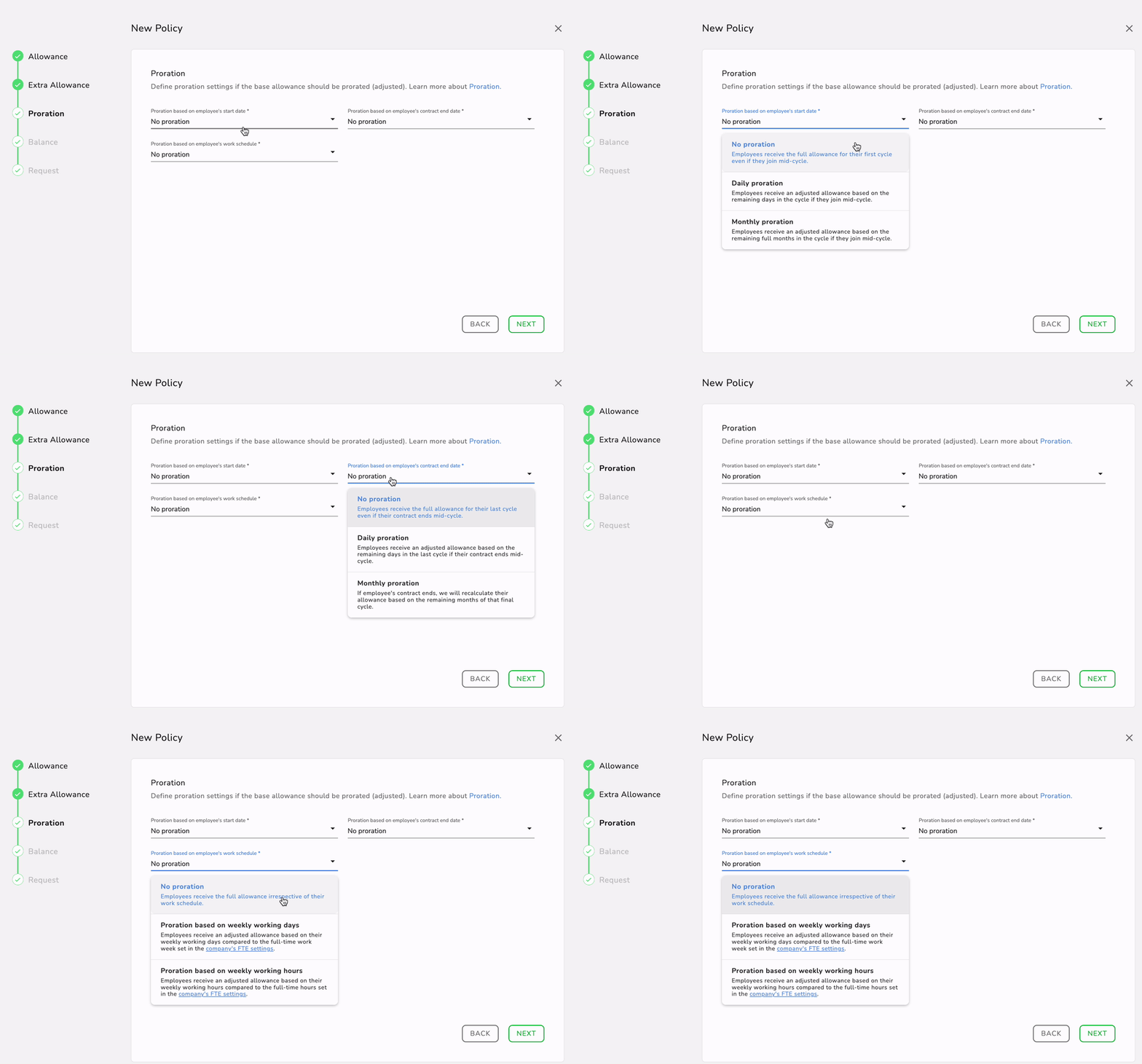
When you are done configuring everything, click on NEXT.
Deduction
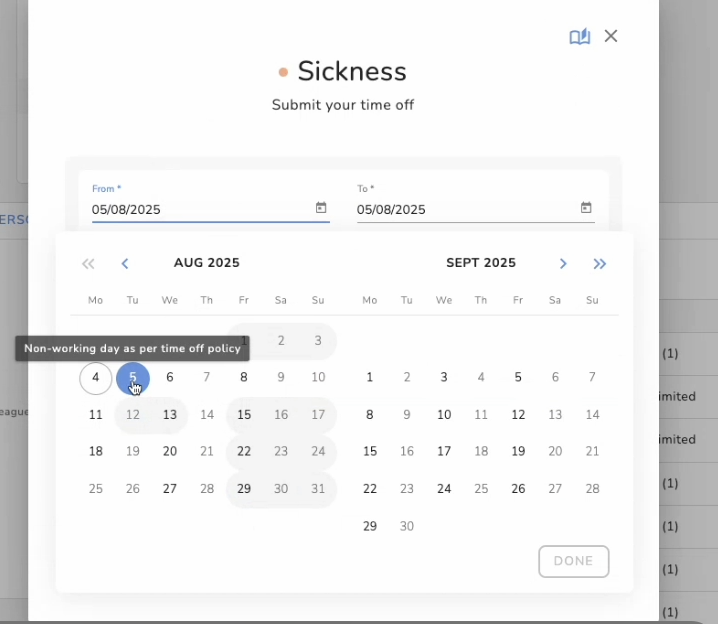
To define this time off policy as customized as possible, you can specify days on which employees covered by the policy are non-working days. A classic use case would be if some employees have a 4-day week and, for example, do not work on Fridays.
- Select from the dropdown whether the deduction rules are based on the employee’s work schedule, on calendar days, or on a custom workweek that you define here.
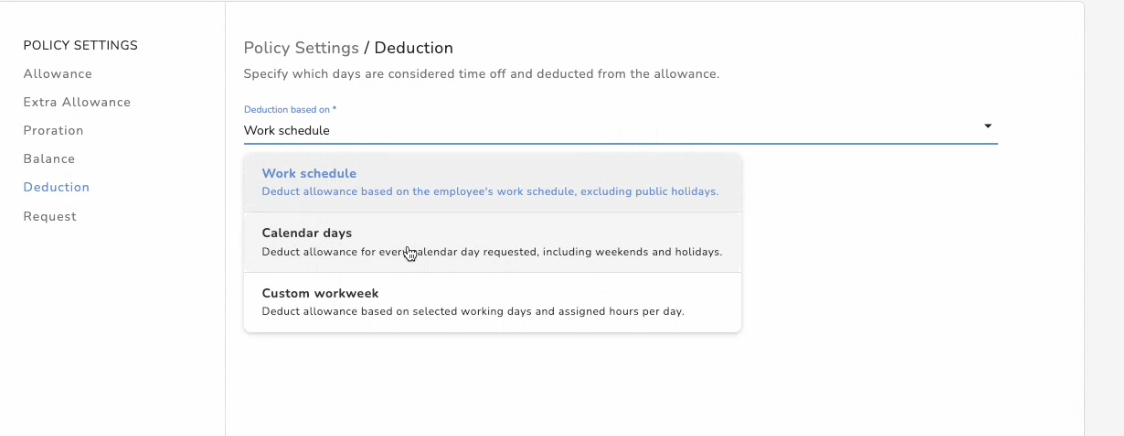
For a custom workweek:
- Define workdays by clicking on the weekdays the employee works.
- Define working hours by setting, for each workday, the number of hours the employee works that day.
- Click SAVE
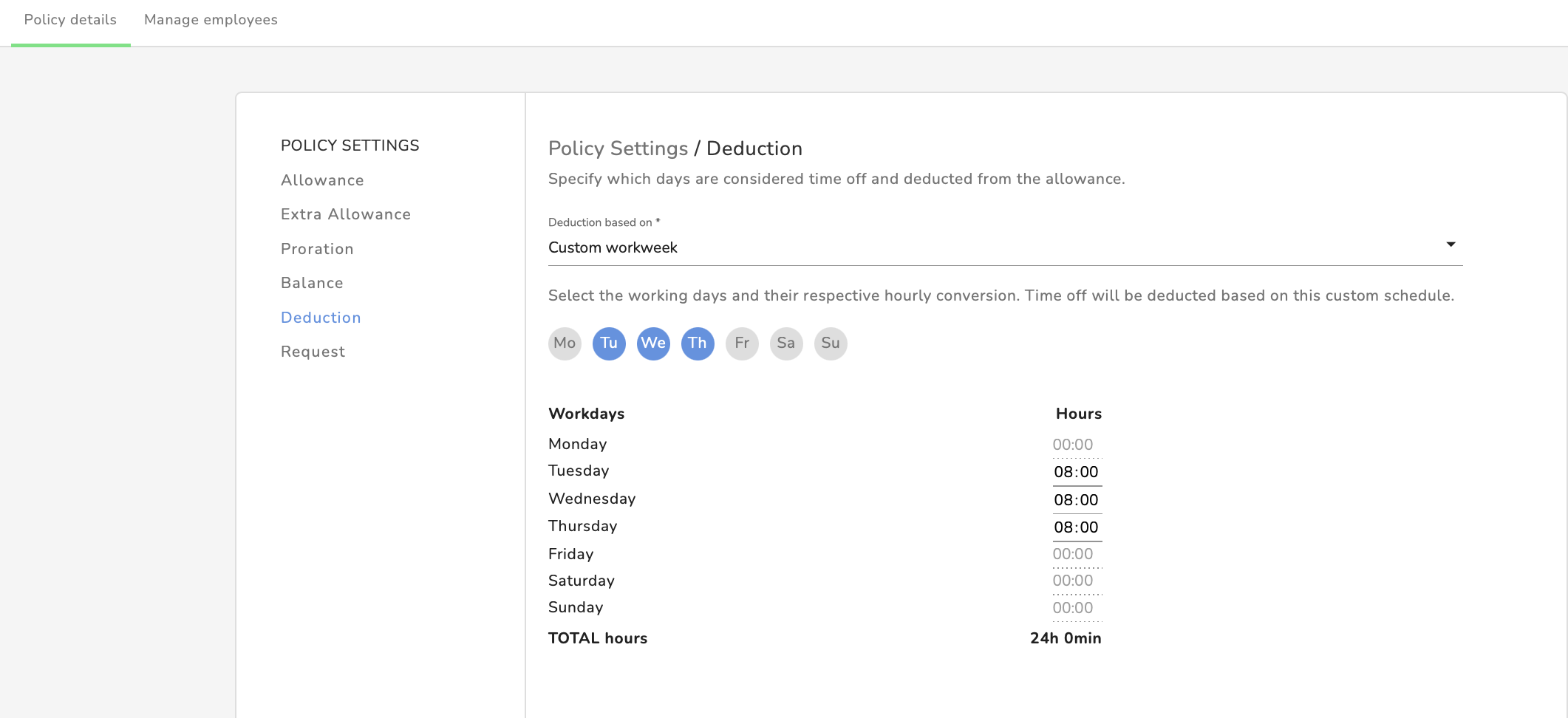
When an employee assigned to this policy now submits time off requests, the days that are non-working days will appear as unavailable.
✅ Review recurring workflows
If you’ve created recurring workflows during the year, please remember that a recurring workflow will repeat every year without you having to change any settings. That’s why it’s a good idea to check whether you still want these workflows to be triggered next year as well.
- Go to Settings > Workflows
- In particular, you should pay attention to the workflows whose object is labeled Recurring workflow.

Was this article helpful?
That’s Great!
Thank you for your feedback
Sorry! We couldn't be helpful
Thank you for your feedback
Feedback sent
We appreciate your effort and will try to fix the article